Not Just a Surf Venue, A Beach Club: How Surf House Helsinki proved a FlowRider can anchor a standalone lifestyle venue — indoors, year-round, anywhere in the world.
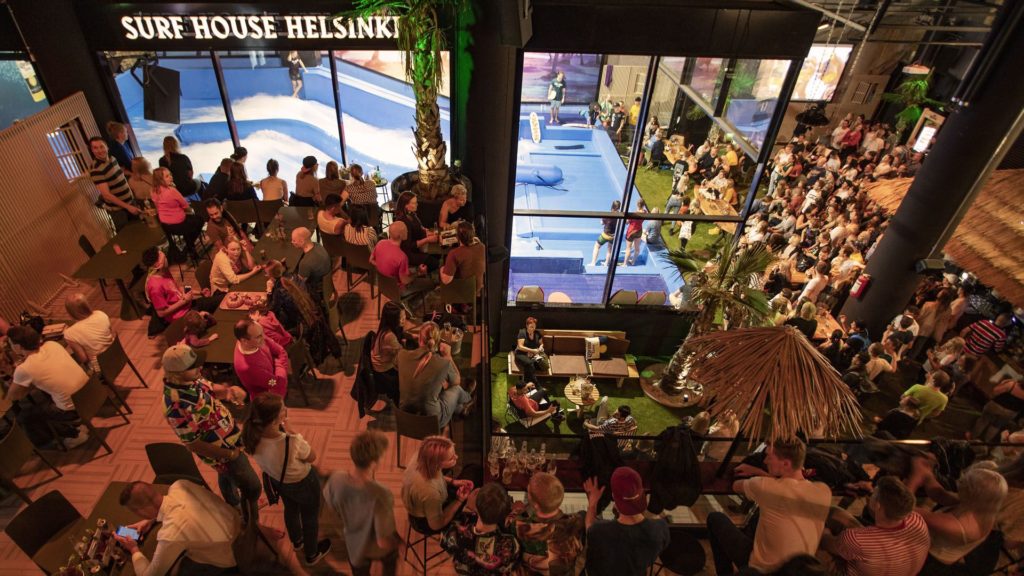
Four floors underground in a Helsinki shopping mall, it is always summer.
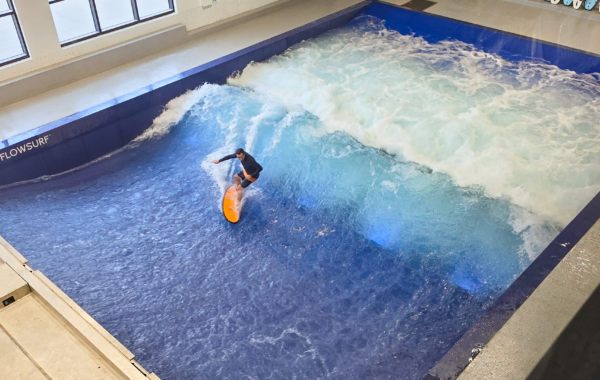
The temperature holds steady at 27°C. Real palm trees sourced from Spain line the space. White sand, imported from the tropics, warms underfoot thanks to hidden electrical heaters. A Mexican kitchen sends the smell of food through air calibrated to feel like a beach, not a spa. And at the center of it all: a FlowRider Double, running two wave sessions simultaneously, drawing riders, spectators, corporate groups, wedding guests, and curious passersby into what has become one of Helsinki’s most unexpected destinations.
Outside, it might be minus 20 degrees, but inside Surf House Helsinki, nobody notices. This is what happens when you stop thinking about a FlowRider as an attraction and start thinking about it as a heartbeat.
The Vision: A Beach Club, Not a Sports Facility
Janne Miikkulainen, co-founder of Surf House Helsinki, had already built FlowRider venues in Phuket — two of them, on Kata Beach and Patong Beach — when he started thinking about what it would take to bring the concept indoors to Finland. He and his co-founders had proven the model in a tropical outdoor setting. The question was whether it could survive a Nordic winter. And more than that, whether it could thrive.
The answer, it turned out, depended entirely on how you framed the concept from the start.
“I never wanted to build a sports facility with just the wave,” Janne explains. “I wanted to build a sexy beach club and instead of a dance floor or a swimming pool in the middle, there is a FlowRider. That was the whole idea.”
That distinction of “beach club first, surf venue second” shaped every decision that followed. The FlowRider was not the product, it was the stage.
Why Finland? The Counter-Intuitive Market
The conventional wisdom says you build a surf concept where surf culture already exists. Janne sees it differently.
“I think it’s a common misconception that you need a surf culture to create a surf concept because you can create that culture when you build a venue. And the concept can perform just as well, often even better, in a place where that culture doesn’t yet exist.”
Finland had something more useful than surfers: it had board sport enthusiasts. Skateboarders, snowboarders, and action sports athletes who already understood the mechanics of riding a board and were hungry for something to do year-round. They became the core of Surf House Helsinki’s riding community who picked it up faster than anyone expected and progressed to kickflips within months.
Helsinki also had something else Janne was watching closely: a corporate events market in the middle of a generational shift. Companies were moving away from the old dinner-and-drinks format toward experience-based events and the city, as Finland’s corporate capital, was full of potential clients.
“There’s a big shift in the type of events that companies arrange, from the old-school dinner and drinks into more experiences and activities. Helsinki has a lot of corporate headquarters and a lot of potential for corporate events combined with the board sports community, that was the combination we were building for.”
Building the Experience: Every Detail Mattered
Getting the wave in was, by Janne’s account, the easiest part. FlowRider’s installation team handled the technical build. The hard part was something no technical spec sheet could solve: how do you make an underground mall feel like a beach?
The team went to extraordinary lengths to answer that question. Palm trees came in from Spain. Tropical white sand was imported and laid across the floors — warm underfoot, a small but telling detail that signals to guests they’ve left the city behind. But the elements that most shape the atmosphere are less visible and often underestimated: the lighting, the sound, and the temperature.
RGB lighting systems allow the team to shift the mood of the entire space — warm sunset tones of amber, red, and orange for an evening session, dynamic color for a surf show, something cooler and more energetic for a corporate event. The right light doesn’t just look good; it makes the space feel like a different place entirely.
Sound is equally critical, and equally easy to get wrong. Surf House invested in a high-quality system with expert speaker placement — designed not just to fill the space with music, but to strategically mask the ambient noise of the FlowRider itself, creating an environment where guests feel immersed in the atmosphere rather than aware of the machinery.
And throughout it all, the temperature holds at 26–27°C — not as a background condition, but as an active design choice. In a city where winter can mean minus 20 degrees outside, walking into that warmth is itself part of the experience.
“We wanted to really avoid creating a plastic type of experience,” Janne says. “How can we make it feel truly authentic? We went into quite a lot of detail on every element. It was complicated at times, but we were very happy with the end result.”
The guests were too. When Surf House Helsinki opened in 2019, it landed all over the Finnish news — a weird, wonderful, underground beach club in the middle of a Nordic city. The hype was immediate, and the sessions sold out every weekend.
The Business Engine: One Third, One Third, One Third
What makes Surf House Helsinki a compelling proof of concept for operators is not just that it worked, it’s that it worked as a diversified, resilient business model.
When Janne looks back at the overall revenue split during their years of operation, one number keeps coming up: roughly a third from surfing, a third from the restaurant and bar, and a third from large private events. Each stream supported the others. The wave drew people in. The food and beverage kept them longer. The events brought in groups who may never have come on their own.
“The key to success was that we could fill almost every hour of every day of the week with different types of clients.”
“Early mornings, regulars doing a session. During the day, a corporate meeting with lunch and a surf show. Afternoons, birthday parties. Evenings, the regular riders and spectators hanging out, using the restaurant, watching the wave,” Janne explains.
The spectator dimension is something Janne feels is consistently underestimated. Not every guest who walks into Surf House Helsinki wants to surf. Many come simply to be there — to sit under the palm trees, order a drink, and watch riders work the wave. That audience is just as valuable as the riders and building for them was intentional.
The corporate events segment became one of the venue’s most significant revenue drivers. The secret? Getting clients through the door. Companies that hadn’t yet heard of Surf House sometimes arrived uncertain, but Janne’s team learned early that the venue sold itself the moment someone walked in.
“Whenever we got someone to come visit, we knew the booking would happen. Because once they saw it, they just realized how cool it was.”
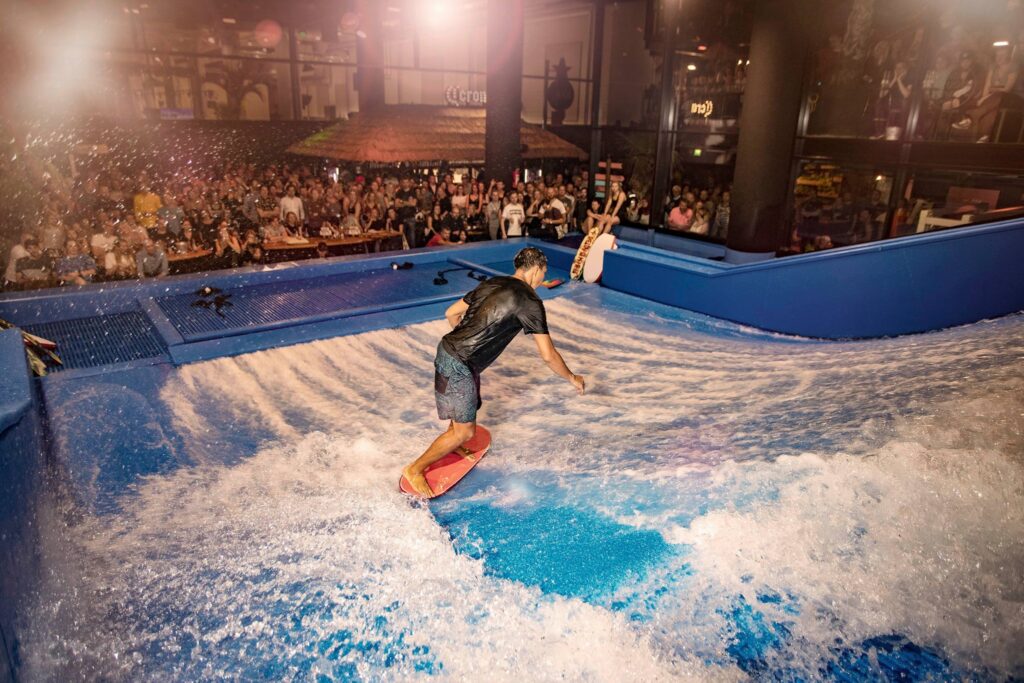
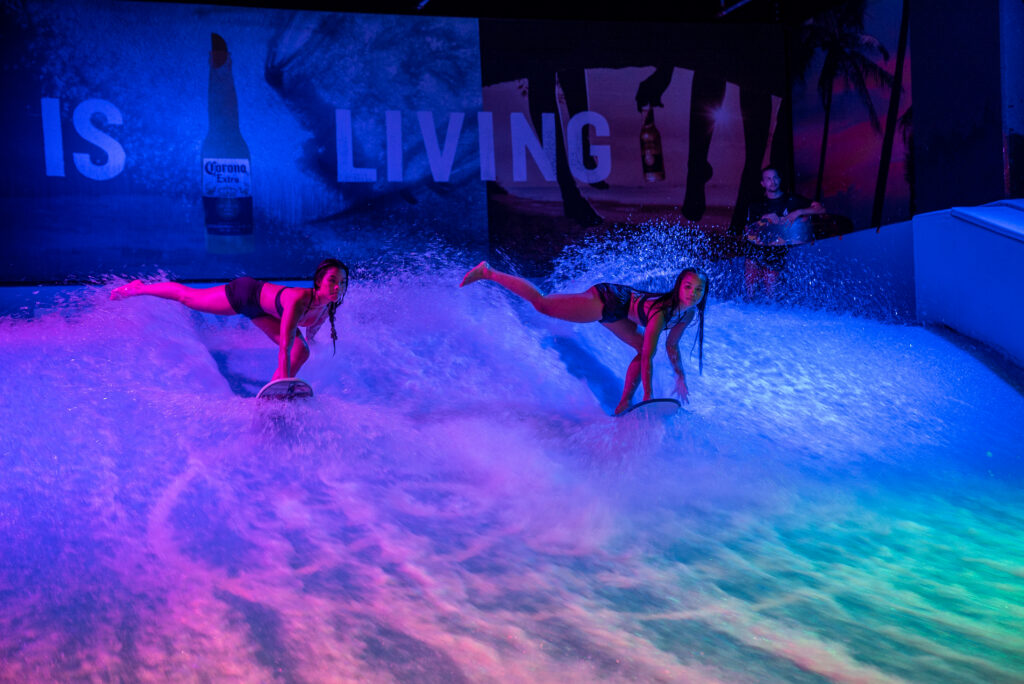
The surf show became a highlight of nearly every corporate event — performed by a team of elite riders Surf House cultivated from its own competition circuit, and almost always the moment the room came alive.
The Community It Created
Before Surf House Helsinki opened, there was no flowboarding community in Finland. There is now.
From its earliest days, the venue programmed deliberately for riders at every level — beginner sessions for first-timers, intermediate coaching sessions for those progressing beyond the basics, and advanced open sessions for the regulars who came back weekly, sometimes daily. A VIP membership program sold hundreds of memberships. Kids who had never touched a board were landing kickflips within months.
From that community, Surf House identified its most promising riders and formed a dedicated Flow Team — athletes who trained for free in exchange for performing shows, representing the venue on social media, and competing on behalf of the brand. They became the face of the wave and a compelling draw in their own right.
“These regular riders are a very, very good marketing tool for the venue,” Janne notes. “It’s important to take care of them.”
One of the most effective growth strategies the team deployed was using music and partnership events to reach an audience that would never have found the venue otherwise. A partnership with Corona Beer brought DJs and artists to the venue, selling tickets to music events that had nothing to do with surfing. People came for the show, discovered the wave, and came back the following week to ride it themselves.
“We used the music as a draw to reach young adults who probably wouldn’t come otherwise. Then they came to the venue, saw the surf show, and realized — hey, let’s come back and try this.”
The FlowRider Partnership
For Janne, the decision to go with FlowRider — and specifically the FlowRider Double — was grounded in experience. He had seen other wave systems fail to deliver financially due to high operating costs. The FlowRider’s combination of performance, reliability, and economics made it the clear choice.
And the relationship didn’t end at installation.
“There’s always the hotline to ask questions and get help if you need it. They are there with you during construction, during installation, during commissioning, and also afterwards. That’s exactly the reason we chose FlowRider. You’re not just signing a sales agreement and getting a product delivered and never hearing from them again.”
On maintenance, the FlowRider Double delivered exceptional uptime across years of operation. Minor electrical matters aside, the wave almost never closed. Wave operators handled routine checks in-house, following manufacturer guidelines, and the machine held up.
The Proof of Concept
Surf House Helsinki ran for several years before being acquired by NoHo Partners, one of Finland’s largest hospitality groups — itself a testament to what the concept had become. What started as an experiment in transplanting a tropical beach club concept into a Nordic underground is now a proven model that operators around the world are looking at closely.
Janne’s message to anyone considering a standalone FlowRider venue is direct: the geography matters less than the ingredients.
“I think the possibilities for this kind of venue are probably bigger in a place where you wouldn’t expect a surf destination. When I talk to people considering this, I always get the response — ‘oh, we don’t really have the surf culture in our country.’ But that’s a good thing. Because you create that culture by bringing it there. That was proven in Finland.”
Location accessibility, a full hospitality experience built around the wave, and smart ongoing programming is are what drives success. Get those right and the wave does the rest.
“Without the FlowRider, there would be no Surf House Helsinki. That’s the heart of it.”