There was a time when a hotel pool was a hotel pool. A rectangle of water, a few loungers, maybe a swim-up bar if the property was feeling ambitious. It checked a box. It was there if you wanted it and forgettable if you didn’t.
That era is over. And the developers who understand that are building something fundamentally different.
The Amenity Is No Longer an Afterthought
For most of hospitality’s history, experiential amenities were added at the end of a development process. The building came first, the programming came second, and the attractions were squeezed into whatever space was left over. The result was a generation of properties where the fun felt tacked on rather than built in.
The experience tourist changed the calculus. This is a traveler who chooses a destination based on what they can do there, not just where they’ll sleep. They’re researching attractions before they book rooms. They’re making decisions based on what a property offers that no other property does. And they’re telling everyone about it, online, loudly, in real time.
For developers paying attention, the message is clear. The attraction is no longer the amenity. In many cases, the attraction is the product.
Designing Around the Draw
The most forward-thinking hospitality developments today are being planned differently. Rather than designing a hotel and then deciding where the pool goes, the conversation is starting with the question: what is the experience we’re building toward, and how does everything else support it?
This is a meaningful shift. It changes the site planning conversation. It changes how investors evaluate a project. It changes what architects are being asked to solve for. When developers, architects, and investors gathered in Berlin earlier this year, the message coming out of the room was consistent. Future winners control the guest experience, not just the asset. Guests no longer want identical experiences across destinations. Personalization and distinctiveness are the new benchmarks.
For a specialist designer tasked with creating something that genuinely differentiates a property, that’s both a challenge and a wide open brief.
The Wave as an Anchor
This is where a FlowSurf installation changes the conversation entirely.
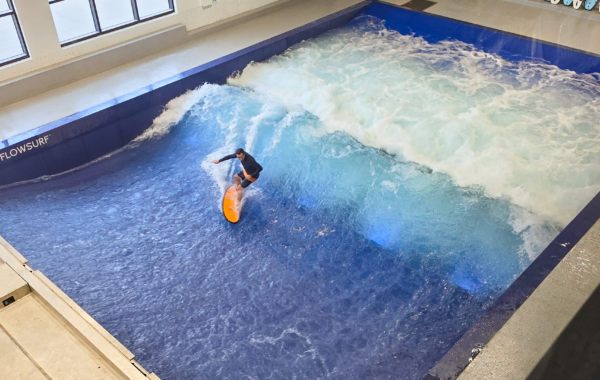
FlowSurf is part of the FlowRider product line and offers a deep, continuous wave experience that functions as an anchor attraction in a way that few amenities can match. It draws a specific, passionate audience, namely surf culture enthusiasts, active travelers, and experience seekers. It operates year-round when placed indoors. It generates organic content every time someone rides it. And it creates a community around the venue that extends well beyond the guest staying in room 210.
For an architect or specialist designer working on a mixed-use resort, a leisure destination, or a hotel with ambitions beyond the transactional, FlowSurf introduces a programming opportunity that is different from anything else in the amenity toolkit. The footprint is flexible, with configurations suited to different scales of development. For properties working with tighter site constraints, the FlowRider Edge offers a compelling alternative, integrating directly into an existing pool and turning an underutilized amenity into an active revenue driver without requiring a dedicated footprint. Either way, the wave works with the surrounding architecture rather than competing with it.
You can see this playing out already at Surflux in Luxembourg, an indoor wave venue built as a destination in its own right rather than an add-on to an existing property.
Success in hospitality development requires convincing all key stakeholders, from owners and brands to operators, designers, and investors. The amenity decisions that make it through that gauntlet are the ones with a compelling story at every level of the conversation. A wave has a compelling story.
What Developers Are Actually Buying
When a developer chooses to design around a wave attraction, they’re buying more than a piece of equipment. They’re buying a narrative. They’re buying a reason for a journalist to write about the property. They’re buying a social media moment that guests create for free on opening day and every day after. They’re buying a differentiation story they can tell to investors, to brands, to operators, and to the guests who haven’t booked yet.
In a market where the experience tourist is increasingly driving the economics of hospitality development, that narrative has real value. It shows up in occupancy numbers, in non-guest revenue, in the length of a guest’s stay, and in the reviews they leave when they get home.
Build It In, Not On Top
The developments that will define the next decade of hospitality are being designed from the experience out. Not from the building in. The amenity isn’t the last decision. It’s one of the first.
If you’re in the early stages of a project and the question of what guests will actually do there hasn’t been answered yet, start there. Everything else will follow.